





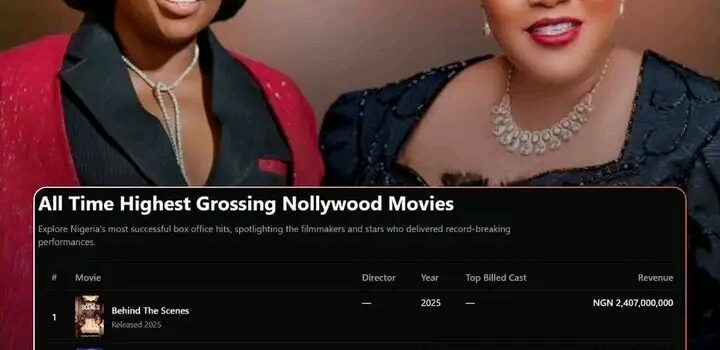
Nollywood has stepped into a new chapter. For the first time in its history, Nigerian films are crossing the billion-naira mark at the box office. What was once an industry known for home videos is now producing cinema blockbusters that pull huge crowds and record massive ticket sales.
The turning point came in January 2024 when Funke Akindele announced that her film, “A Tribe Called Judah,” had earned over N1 billion in Nigerian cinemas. The news sparked celebration across social media. Fans praised her achievement and many called it a proud moment for the industry.
By the end of its cinema run, “A Tribe Called Judah” reportedly made more than N1.06 billion. Not long after, Akindele returned with “Everybody Loves Jennifer,” which raised the bar again by earning N1.8 billion. In January 2026, she pushed the record further with “Behind The Scenes,” which reportedly generated N2 billion within two months.
Her success did more than boost her personal profile. It raised the ambitions of other filmmakers. Actress and producer Toyin Abraham followed with “Oversabi Aunty,” which grossed N863.2 million in just one month, placing it among the highest-earning Nigerian films in West Africa.
Other titles have also delivered strong results. These include “The Wedding Party,” “Chief Daddy,” “King of Thieves,” “Brotherhood,” “Merry Men,” “A Trip to Jamaica,” “Jagun Jagun,” “To Kill a Monkey,” “King of Boys,” “My Mother is a Witch,” and “Omo Ghetto: The Saga.” Together, they show how far Nollywood has come in commercial terms.
Still, the big numbers have sparked debate. Some observers question whether box office figures reflect true profit or simply serve as strong marketing tools in a competitive market. As more money flows into cinema releases, calls for transparency and proper reporting have grown louder.
From Mobile Screens to Modern Cinemas
Nollywood’s journey did not happen overnight. While many trace the industry’s rise to the video boom of the early 1990s, cinema culture in Nigeria goes back much further.
In the 1920s, colonial filmmakers screened motion pictures for local audiences using mobile cinemas that traveled from town to town. By the late 1930s and 1940s, Lagos had become a cinema hub with popular venues such as Rex, Regal, Royal, Capitol, Odeon, and Glover Hall. These locations built a culture of watching films in public spaces long before Nollywood became a global brand.
Today, cinema releases are the clearest sign of commercial success. Higher ticket prices and strong marketing campaigns have helped create blockbuster fandoms. The shift from small video productions to billion-naira cinema hits shows how Nigerian filmmaking has evolved.
The Money Behind the Numbers
While billion-naira figures grab headlines, they do not tell the full story. Box office revenue is shared among cinema owners, distributors, and producers. The final amount that reaches a producer depends on agreements made before release.
Filmmaker and actress Efe Irele explained that gross earnings should not be confused with profit. “High grosses show that people loved the film and kept coming to watch,” he said. “But it’s important to remember that the gross isn’t what producers take home. It is a measure of audience engagement. Some people watch multiple times. Some buy entire rows of tickets for staff or friends. These figures indicate that Nollywood is breaking barriers and is worth investing in.”
He further described how earnings are divided. “In Nigeria, cinema revenue is layered. Cinemas typically take a percentage of ticket sales, and distributors also take their cut for handling logistics and marketing. What remains after these deductions is the producer’s net revenue. The exact split depends on pre-agreed terms, and you need a competent team to manage this. Marketing can make or break a film. You can have an amazing story, but if no one knows about it, people won’t come. Smart promotion turns curiosity into ticket sales. Just look at what Toyin Abraham and I achieved with Oversabi Aunty.”
On the issue of trust and accountability, he added, “Clear reporting, digital tracking, and open communication between cinemas, distributors, and producers build trust. When everyone sees the numbers, filmmakers can make smarter decisions and investors feel confident.”
Filmmaker Biodun Stephen also weighed in. “The billion-naira conversation is inspiring, but it is incomplete. It shows what Nollywood can achieve. Yet, we need to understand the business structure. Sometimes cinemas make more, but creators also earn from streaming platforms like YouTube. That side of revenue is rarely discussed.”
From the cinema side, Filmhouse Group says there are systems in place to ensure accuracy. Winifred Wessels, Head of Marketing at the company, explained how revenue is tracked. “Every transaction, online or at the box office, is recorded in real-time, giving immediate visibility into admissions and revenue. Beyond internal systems, the industry relies on Comscore, a global media measurement platform. It aggregates data from participating cinemas nationwide, offering transparency and consistency in box office reporting. Publicly reported figures are typically drawn from Comscore, the most widely accepted source in Nigeria.”
Dr Shaibu Huseini, Director General of the Nigeria Film and Video Censors Board, also confirmed the credibility of the figures. “The figures correspond with actual admissions, and ticket prices—N7,000 at the time of release—validate the revenue claims. We rely on Comscore as the official source and carry out occasional checks to verify reports from cinemas,” he said.
Despite these systems, some filmmakers admit they do not always know the exact percentage that reaches them. In some cases, distributors and legal teams handle financial details, leaving producers to focus on recovering their investments.
Nollywood’s journey to billion-naira box office success marks a major shift in the industry’s history. From mobile cinemas in the early 1900s to modern multiplex releases, Nigerian filmmaking has grown into a powerful commercial force.
While debates about profit sharing and transparency continue, one thing is clear. Nollywood has entered a new era where ambition, strategy, and creativity are driving record-breaking results. As the industry evolves, attention will likely turn to stronger reporting systems and new revenue streams that shape its future.
Comments